Architecture, ART, Attractions, Cruising, Decorative Arts, DESTINATIONS, Gardens, International, Road Trips, TRAVEL

Pretty Little Passau

5p-ooo-6TRAVEL THERE: THE FINAL SHORE EXCURSION

Waking up in Passau was bittersweet.  During the night we’d passed from Austria into Germany and docked at Passau, but my research had not mined up any nuggets for my “must-see” list, in this town at the confluence of three rivers.  The overwhelming emotion was regret.  I was going to have to leave this cozy boat where they took me from destination to destination, fulfilling my every need and desire along the way. 

The Morning Rush Hour

In Viking River Cruise land, mornings were busy.  We had to get up and get breakfast before the tour started.  There were no lazy days at sea. It might have been nice to intersperse all these activities with some down time, but Mr. Bill is not a two week vacation kind of guy and on an 8 day river cruise you are engaged every single day, all day long.

Passau was no different.  The walking tour began at nine.  After a delicious breakfast we disembarked and found our guide.  We did not get the pick of the litter.

The Walking Torture

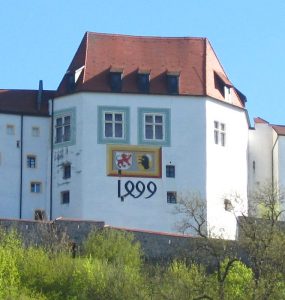
So what date do you think this is?

He was a Frenchman, resettled into Germany and I’ll just say it, he was rude.  He was quite knowledgeable, but so unpleasant.  He was obviously unaware that we were on a walking tour, not taking an oral exam for a PhD.  He’d pepper us with questions and then ridicule our answers.  If we dared ask him a question, he’d belittle us.  I’m not exactly ignorant of history, but the one question I asked him about a date painted on a castle, resulted in my most uncomfortable moment of the cruise.

We  put up with him for a while, but it was finally so unpleasant that we wandered off and found our own way back to the boat.  However, Passau is a lovely little town, in spite of the rude guide, so I’ll show you some of it.

Pretty Little Passau

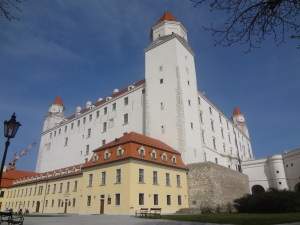
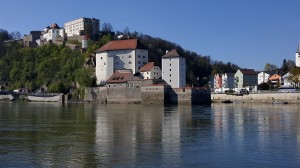
If you’ve been following me along on this cruise, then you know the operative word for the predominant architectural style along the Danube is Baroque.  We got a taste of the Middle Ages and the Renaissance in Cesky Krumlov, but pretty much everything else has been Baroque-on-steroids.  Passau was no different.  The architectural highlights are the Prelate’s Palace and St. Stephen’s Cathedral, but the whole town is lovely.  For some reason, the Rathaus has murals painted all over it which are reminiscent of the Middle Ages, but they are merely modern interpretations of that era.  Architecture aside, the three rivers are the real stars of the show.

Enjoy this gallery of shots from our walking torture.  I can’t tell you much more about them, because the only way I was able to avoid killing my guide was to ignore him.  We finally abandoned him and made our own way back to the boat.  Come back next week and I’ll tell you about the rest of the day, which was a lot more fun.


Architecture, ART, Attractions, Decorative Arts, DESTINATIONS, Gardens, International, Road Trips, TRAVEL

A Quick Stroll through Cesky Krumlov Castle

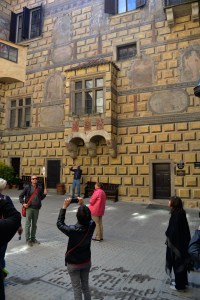
Castle Courtyard
Castle Courtyard

TRAVEL THERE: TAKE MORE TIME HERE THAN WE DID

Cesky Krumlov Castle is a treasure trove of history, architecture and decorative arts.  Let’s start with the history.

The Medieval Lords of Krumlov

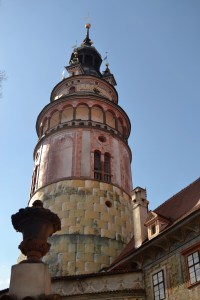
There’s not much left from the Middle Ages, but this has been a castle since the 13th century.  The one remaining tidbit is the castle tower, left over from the days when the castle’s first job was defense.  According to Rick Steves, if you go up its 162 steps you’ll get a find view of the Czech countryside, but I wouldn’t know.

Moving on to the Renaissance

4ck-castle-30While the tower is Medieval, it’s decoration is not.  That’s all Renaissance, so let’s move up a few years.  When the Krumlovs died out, their cousins, the Rozmberks, moved in.  (Rozmberk is often rendered as Rosenberg, but let’s be Czech about this.)

The Krumlovs had been your basic local gentry, but their cousins were a whole different animal.  The Rosmberks went on a serious building campaign, but don’t let the pictures fool you.  Those walls in the courtyard are just plaster.  All the fancy stonework is merely painted on.  They weren’t being cheap, it was just the style.  In fact, they probably could have gotten the stonework cheaper than the painting, but they were all about the show.

Everything had to look modern and up-to-date for the Rozmberks.  They turned that practical, defensive tower into a folly of astrological signs and symbols.  I’m not sure who came up with the idea of a pastel yellow and baby pink as an acceptable color combination, but I would like to complain about it.  Pink and beige were often used together throughout this region, too.  Both color themes make me a little nauseous, but they were all the rage apparently, based on the frequency of their use.

While I didn’t approve of their color schemes, I have to admit they did do a great job out in the gardens.  The glorious Renaissance gardens in the French style, with a magnificent central fountain, were something to see.  It was a little early in the season for floral displays.

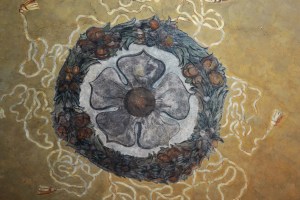
They symbol of the Rosenberg family can be found all over the castle.
They symbol of the Rozmberk family can be found all over the castle.

Visions of Grandeur

It wasn’t enough for the Rozmberks to have the best castle around, they wanted to climb even higher on the social ladder. So they decided they wanted to be kin to the the Orsinis, who were ruling the roost over in Italy.

Now there are a number of stories about their claim to Orsinism.  Some say they just added a fake limb to their family tree and were powerful enough to pull it off with aplomb.  Others claim they actually did have a legitimate claim.  My favorite story is they expressed their desire to be Orsinis to that family and for X amount of money, the Orsini’s adopted them.  That sounds about right from what I know of the Orsinis.

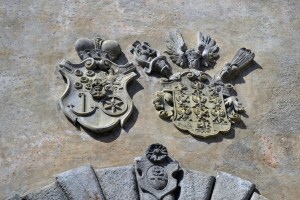
The Crest of the Orsini-Rosenbergs
The Crest of the Orsini-Rozmberks

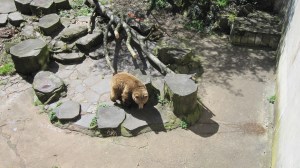
Whichever story is true, the Rozmberks celebrated their promotion in a couple of ways.  They altered their family crest and added a bear to their moat, because as we all know, Orsini comes from the Italian word for bear.

When I titled this post as “a quick stroll” I’m referring to the way I saw the castle – almost at a dead run!  We were in and out of the castle environs almost before I could get out the camera for a few photos.  (Confession, we did not take the bear picture.  It’s off the Viking memory stick we purchased.  The bear hid from us during our quick stroll.)

cesky-krumlov-58What’s more, the tour was only outside and we didn’t get so much as a peek inside.  Museum Girl was about to have a fit.  Here she had a well-furnished Czech palace to check out and we’re ripping through the courtyards at a fast pace.  One of the reasons the castle is well-furnished is because once a Hapsburg-related family gained control of the place it fell out of favor and became a sort of over-sized attic.

Another reason you can enjoy the castle in its former furnished glory is because Czech curators share better than Americans.  They actually try to get the various bits and pieces they find to the appropriate castles.  Because Cesky Krumlov Castle spent so many years as a warehouse of out-of-fashion and damaged furnishings, there are still huge areas of the castle that are still cleaned out and cataloged.  When they find a piece that seems to belong to another castle, they send it along with their regards and curators at other castles do the same.  American curators seem to share a penchant for hoarding.  The bowels of their institutions hold tons of items the public never gets to see, because the museums hold on to every bit they get for dear life.  I liked the Czechs even better for this little tid-bit.

4ck-castle-24Once we’d checked out the bear pits we had a choice to make.  We could either head to the ticket office and go on one of the interior castle tours or we could head out to the picturesque town. The town is charming and I had a wonderful time with our cruise buddies, but Museum Girl was about to go into melt-down.

I’ll share a treat with you.  While I didn’t go through the castle, someone on the Viking crew did and they got some marvelous pictures, which I’ll include at the end along with more of my pictures of the exterior, but there’s one more bit of history you need to know about Cesky Krumlov.

The Baroque Theater

I chose to get a degree in Performance instead of Literature and I’m glad, because to get the degree you have to have a smattering of all the arts, including the performance arts.  One of my classes was the history of theater and I thoroughly enjoyed it.  (The professor was somewhat of a kook, but welcome to the university!)

We studied all the old playwrights and reviewed the various venues.  I reveled in the Renaissance era when cathedrals used to fly children through the air on wires as cherubs.  (No child labor laws to contend with.)  However, the Baroque period was also something.  Every castle worth its appellation had its own theater and each theater proprietor tried to outdo the other on special effects – only there was no digital CGI.  They used actual flames and fireworks to get their effects.  And that’s exactly why there are only two of them left in the world.  Cesky Krumlov is one of them!

It killed me to forego the pleasure of touring the theater.  If I ever get back to the Czech Republic, wild horses won’t keep me away from taking every tour offered in Cesky Krumlov.  Now enjoy the pictures and come back next week for a tour of the town.


Architecture, ART, Attractions, Cruising, Decorative Arts, DESTINATIONS, International, TRAVEL

Going to the Chapel (and the Buffet)

3m-44TRAVEL THERE: THE CHAPEL AT MELK ABBEY

Pretty amazing, huh? Last week I told you about my recent visit to Melk Abbey and compared it to a unique experience I’d enjoyed during a previous visit.  While the rest of the abbey suffered from the absence of my original guide, you really don’t need a guide in the chapel.  Anywhere your eye lands is remarkable.

The Chapel of Baroqueness

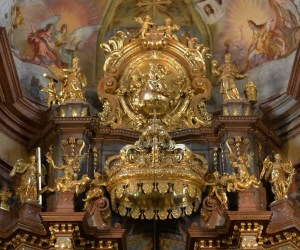
Though I’d spent much of the previous day gawking at the Hofburg Palace in Vienna, when it comes to over-the-top Baroqueness, the palace didn’t hold a candle to the Melk Abbey Chapel.  I could wax eloquent over the charms of the chapel, but I’ll just let a few photographs do the talking.

Back to the Boat

With all of our senses beaten to a bloody pulp of Baroque over-stimulation, we had a choice to make when we left the chapel.  We could either grab a bus back to the boat or stroll to the dock through the small town of Melk.  For once, Mr. Bill was the more adventurous.  I still hadn’t thawed out from our wait in the courtyard, so subjecting myself to more punishment seemed foolish.  I hot-footed it to the buses with the other elderly and handicapped people, because I was feeling very elderly and quite handicapped.

The first order of business was a very long, very hot shower.  Cocktail hour was approaching.  Bill strolled in just about the moment I was strolling out.  The cocktail hour was preceded by a presentation about other Viking cruises available.  Bill had no desire to be enticed into booking our next cruise, so I went and wished on my own.

taste-of-austria-9A Taste of Austria

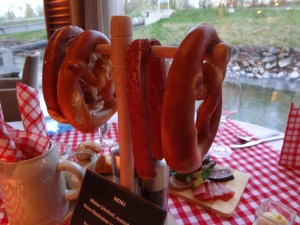
As far as the crew was concerned, this was a big night.  Instead of our usual leisurely dinner, we were having an enormous buffet of Austrian treats.  Each table was tricked out with checkered tablecloths and racks of huge pretzels.   The chic sophistication of the dining room was subjected to an oom-pah-pah polka band, while our wait staff donned dirndls and lederhosen.

I can’t say I was a fan.  While most of the food was good, the pretzels were a disappointment (much too tough by my American standards) and brats are not my favorite things.  However, what they missed in culinary quality they made up in gourmand quantity.  I will give them these accolades, the effort at entertainment was remarkable and the local wines they served were outstanding.

Time for Bed

After dinner we were offered a dose of Mozart in the lounge, but the foodfest was such an ordeal that I can’t even remember whether we made it to the presentation or not.  If we did, I didn’t gain any new insights into the eccentric genius.  I do remember crawling into bed in utter exhaustion.

I’ll leave you with a summary video of our day in the Wachau Valley.  Come back next week and we’ll visit our next stop along the Danube.


Architecture, ART, Attractions, Cruising, Decorative Arts, DESTINATIONS, International, Libraries, Museums, Road Trips, TRAVEL

Marvelous Melk Abbey

3m-41
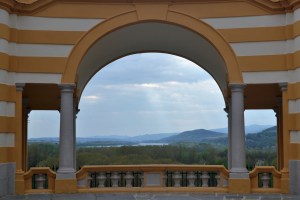
A peek at the Wachau Valley from inside the Abbey walls

TRAVEL THERE: THE GLORIES OF BAROQUE IN SPADES

A Return to Marvelous Melk Abbey

Of all the places I’ve traveled to over the years, Melk Abbey qualifies as one of the most remarkable.  All they need in the dictionary, to define the word Baroque, is a picture of the chapel’s interior.  But that dictionary doesn’t have enough words in it to adequately describe the wonders you will see inside the abbey.

Melk Abbey has become somewhat of a tourist trap in the days since my last visit, 3-4 decades ago.  I remember parking on the street, strolling over to the abbey and having a private tour with my small busload of tourists.  This time I disembarked along a riverside crowded with cruise boats and hordes of people heading toward the abbey.  Do not be dismayed or discouraged.  Just line up and go with it.  The abbey is worth your time and the hassle of dealing with tourists and guides.

The weather was miserably cold and damp, while my gear was sadly inadequate.  What was intended to be a pleasant stroll through a garden and a chance to visit a small outdoor cafe, was instead an overlong huddle in the abbey’s courtyard.

Eventually the ubiquitous Viking guides, with their red jackets and numbered signs, showed up to talk us through the experience.  Since my last visit, the abbey has had some renovations and remodeling, adding several exhibit rooms displaying a wonderful array of abbey treasures.  While the exhibits are truly extraordinary, I would have easily traded them in on the opportunity to see my first guide just one more time.

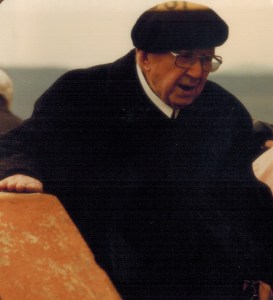
bps10032016_0001The Charming Abbot Emeritus of Melk

And here’s the reason I enjoyed my first visit to Melk ever so much more than I did my return.  The sweet little man in this photo had been the abbot of this remarkable place for many years and he loved it almost as much as he did God.  He’d been retired from running the place for only a little while and had been assigned the joy of sharing it with others.  During the tour he’d come to a closed door and look around surreptitiously to see if anyone was watching.  If the coast was clear, he’d wrench open the door and say, “I’m not supposed to show you this, but I didn’t want you to miss it.”  Then he’d go on to tell us a marvelous story about something that happened in the room or a tidbit about the artist who decorated it.

I loved him so much that I wanted to bundle him up and take him home with me.  My admiration for the place was obvious and he begged me to come back some time and visit him.  He confided that when there wasn’t such a crowd, he could show me other places in the abbey.

That small busload of travelers would have been lost in the horde of  tourists on my latest visit.  I wonder what my friend would have thought about the abbey’s popularity.  The guides did a great job of sharing architectural highlights, but they were completely devoid of the affection the Abbot Emeritus displayed. I’ve always wished I could have returned for the promised private tour, but life changed for me after that trip and it was a long time before I crossed the ocean again.  Too long of a time for the Abbot Emeritus to give me a tour.

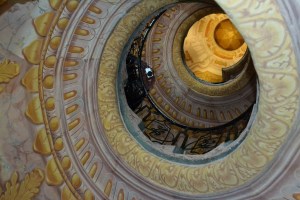
Trompe-l'œil tricks the eye into thinking there's a dome above the stairwell.
Trompe-l’œil tricks the eye into thinking there’s a dome above the stairwell.

Gorgeous Melk

Even without the Abbot Emeritus to show us around, the wonders of the abbey are apparent.  This guide was quite good about rolling off pertinent dates of the abbey’s history, but she was not as insistent about keeping our eyes focused upwards.  In every room the Abbot Emeritus told us to look up, as he described in detail the story of the ceiling frescoes.  The average tourist probably misses the wonder of contemplating the effects of  trompel’œil.

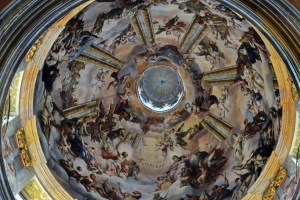
Sure the ceilings are beautiful, but gazing up your eyes are tricked into thinking you are looking up at arched ceilings and domes.  It’s all an optical illusion, because the ceilings of the abbey are flat.  There is one stairwell where the tour highlights the painted effects, but they are ignored in the rest of the abbey.

This is not a dome!
This is not a dome either!

The guide also didn’t tell us any of the enchanting tales of the artist, tales of which I’ve long forgotten the details, but I had hoped to be reminded of during this visit.  Nor did she explain in detail the meaning behind the elaborate frescoes.  She was pedantic about the many ways the features of the abbey were Baroque in nature, but I was more interested in being reminded why they were unique.  

Eventually, I gave up and quit listening to her.  Instead I recalled the chuckles of glee my first guide shared with me and I wandered about mouth agape.  I tried to jog my memory for the details of the frescoes and their painter, but they’d gotten lost somewhere along the way.  More than once I stumbled into a fellow tourist because my eyes were glued above my head, rather than at my immediate surroundings.

I’ve saved the best for last, but in the meantime ran out of words for today.  Come back next week and we’ll visit the chapel.

Architecture, ART, Attractions, Cruising, Decorative Arts, DESTINATIONS, International, Performing Arts, Road Trips, TRAVEL

Durnstein, Gateway to the Wachau Valley

3D Tor (35)TRAVEL THERE: DARLING LITTLE DURNSTEIN

Going on a cruise, in some ways, is like travelling for dummies.  All I had to do was show up for a spoon-fed itinerary.  Sometimes that was great, like Budapest and Vienna.  Then again there were the Bratislavas out there, where things were not exactly the way I  wanted it.  Had I been planning a road trip through Austria, I doubt Durnstein would have made the cut, but having been there on a cruise, I found it a perfectly charming place to spend a morning.

3D (7)On Your Own or By Shore Excursion?

I knew less than nothing about Durnstein and what research I was able to do didn’t tell me much else.  Alone, I may have taken a hike up to the craggy ruins of Durnstein castle, but instead, I reserved spots for Bill and I on the Optional Shore Excursion.  I figured after Vienna he’d be pretty well done with me and my explorations – and I was right.  Even though we had to pay extra for the escorted walking tour, Bill was happy to do so.

The town is so tiny that it would be impossible to get lost, so we didn’t really need a guide.  In addition,the town has exactly one significant historical fact associated with it – Richard the Lionhearted was held for ransom in the castle on the hill.  The only other item of any interest was Princess Di and Dodi Fayed meeting there for their romantic trysts.  It’s funny the only claims to fame for this charming little place on the Danube River were both related to the British throne.

While I can’t exactly recommend the escorted walking tour as a good value, you absolutely must walk through the winding cobblestone streets and get a feel for the place.  I wished for a little freedom to check out the shopping opportunities, but the tour trotted right past them – perhaps because it was so early.  The walking tour began at 8:30 AM and that’s just about the time all the lorries were making their deliveries.  There was actually a traffic jam!

3D (25)The Crown Jewel of Durnstein

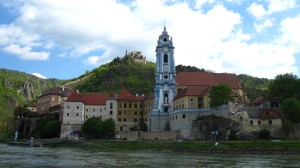
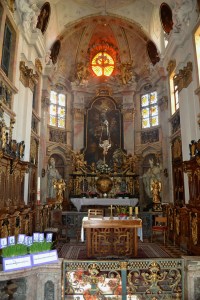
The tour ended at the church where we were delivered for an organ concert.  On the outside, the church, with its blue and white tower, looks much like other churches in the area.  What sets it apart is the interior.  During the 1700’s, it was renovated by one of its abbots.  Our day would be book-ended by abbey churches and Melk Abbey is, without a doubt, the most over-the-top religious edifice I have ever seen.  Still Durnstien, while smaller, gives Melk a run for its Baroque money.

Before the organ concert we were guided through an odd hallway along a series of alcoves filled with scenes from the Bible.  That was a little weird, kind of like window-shopping for a Bible story, but the guide who attends the church was quite proud of them.  Then we were seated in the pews and the organ concert began.

Organ concerts are an acquired taste and this organ had a sort of wheezy, high pitched shrill to it.  We were informed of the uniqueness of the small organ and the talent of the organist. I’m glad to have heard it, but would have been happier with a smaller taste of its product.

3D (41)Should you go to Durnstien, skip the escort and wander the enchanting lanes on your own.  Do see the interior of the church and if the concert is available, by all means take a seat and listen.  Then tighten up the laces on your hiking boots and head up the hill to the castle.  We didn’t have time for it, but those who went there, instead of taking the escorted tour, raved about the view.

From the church we strolled along the river’s edge and enjoyed the beautiful morning.  This seems to be a different Danube than the one we enjoyed earlier in the cruise.  It actually is the same river, but so quiet and so bucolic, that you can’t imagine it is also the lifeblood of vibrant cities like Budapest and Vienna.

I’ll leave you with various scenes from the lovely little town and next week we’ll visit the Wachau Valley,  a UNESCO Heritage Site.


Architecture, ART, Attractions, Cruising, Decorative Arts, DESTINATIONS, Gardens, International, Museums, Road Trips, TRAVEL

The Hofburg Palace Treasury

3V T (14)TRAVEL THERE: HOW DO YOU SPELL EXCESS?

Exiting from the Hofburg’s Imperial Apartments in Vienna, we discovered it was still raining on our parade.  A little morning precipitation had been disheartening.  To discover drizzle still dominating the day was downright frustrating.

Mourning the Loss of Plan A

I know my husband.  It’s all well and good to spend a few hours in a museum and the Imperial Apartments were extraordinarily fine museums, but I’d better have something else besides museums on the agenda.

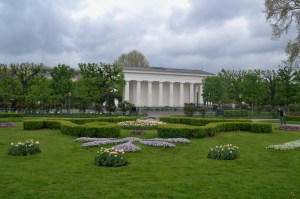
Plan A was designed with just that in mind.  Next door to the palace is the Volksgarten.  We’re talking European next door, not American.  That means right across a small street from the exit of the Imperial Apartments is this popular garden.  We were supposed to catch our breath from all that royal grandeur in a lovely garden which just happened to have a coffee kisok right there.  It was perfect or at least it should have been.

The glorious Volksgarten is not so inviting in the pouring rain.

Instead, the main thing we wanted to do was get out of the rain.  I half-heartedly offered up chocolate at Dremel or a visit to the Dortheum, an auction house he’s shown an interest in.  I know either one would have been a good choice, but right then all he wanted to do was get out of the rain.  Well, he’d probably have been perfectly happy to take a taxi back to the boat and see what kind of pastries were available at the free coffee bar.

Because he loves me, he wanted me to see the most important things on my very long list of must-see attractions, but he wasn’t thrilled about it.  A part of me whispered that I should get this man back to the boat and let him browse the coffee bar, but I was afraid that if I did, I’d miss everything else on my list.  He doesn’t approve of me wandering around strange cities without an escort of some kind and once he was back on the boat, I’m betting dynamite would not have gotten him off it for yet another subway ride and more stomping around in the rain.

As I stood there with all of this floating around in my mind I mourned the possibilities I’d wished for.  I’d imagined Bill in the Volksgarten, with his cup of coffee in hand, oooohing and aaaahing over all the wonderful options we had to choose from.  Instead the chill of the mist was invading our crevices and Bill became impatient with my list of attractions.  “What are we closest to that’s inside?” he wanted to know.  “The Treasury,” I replied,”but it’s a museum.”  He said, “lead the way.”

Back into the Hofburg

Thanks to my friend, Rick Steves’ Eastern Europe guide book and DK Eyewitness Travel’s Top 10 Vienna, I knew my way around the palace.  I led Bill through a tunnel to the In der Burg courtyard, through the Swiss Gate to the Schweizerhof which held the Treasury.  Part of me whispered I was making a big mistake, but this was number two on my list of must-see’s and it was out of the rain, so I didn’t know what else to do.  I think this was one of those lose-lose situations and there had not been a correct answer to the drizzle dilemma.

We were wowed by the Treasury.  Bill’s fatigue was dispelled as he began photographing everything in sight.  I kept trying to put it all together.  This was the fourth day of the cruise and all four days had been dominated by the Hapsburg Dynasty.  We’d already seen so many remarkable sites associated with their wealth, grandeur and power.  I couldn’t get over the fact that the Hapsburgs toted all this stuff around with them wherever they went.  I’d assumed that each of their many castles had it’s own set of china and flatware, but instead the emperors and their entourage packed it all up in velvet and silk lined leather boxes to carry it with them.  After all, an empress never knows when she might need several hundred silver charging plates.

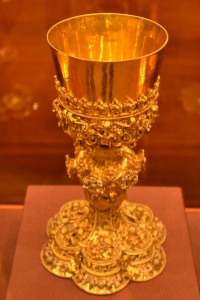
As if the Silver Collection of the Imperial Apartments had not held enough treasures for any dynasty, we were now in a treasury which was chockablock with more golden, silver and jeweled wonders.  At some point my disbelief checked itself out and I just wandered around awestruck.

I’ll share some of the pictures Bill took.  Then you come back next week and hear how my dream day in Vienna continued to disintegrate.


Architecture, ART, Attractions, Cruising, Decorative Arts, DESTINATIONS, International, Museums, Road Trips, TRAVEL

The Rest of the Imperial Apartments

In between the wonders of the Imperial Apartments

TRAVEL THERE: COMING DOWN OFF MY DECORATIVE ARTS HIGH

So we’re in Vienna on Viking’s Danube Waltz Cruise.  I’ve just been through the Silver Collection of the Hofburg’s Imperial Apartments and my excitement level is at about 27 out of 10.  The Hofburg allows you to take all the photographs you want in the Silver Collection, but you have to put your cameras away for the Sissi Museum and Imperial Apartments, so you’re imagination (or the internet) will have to provide the visuals.  

The Sissi Phenomena

Austrians love their Empress Elizabeth and I can’t exactly figure out why.  Her story starts out pretty well.  Beloved daughter of obscure Bavarian royalty enjoys an idyllic childhood.  In her early teens, she tagged along on a trip with her big sister, who was being checked out by the Crown Prince of the Hapsburg Dynasty as a potential mate.  Once old Fredrick laid eyes on Elizabeth, big sis was toast.  Within days, Freddy and his “Sissi” were engaged, to the extreme joy of everyone in Europe, with the exception (perhaps) of big sis.

A few days later, the story changes.  Sissi is a drama queen.  She starts wringing her hands and emoting all over her diary.  Poor pitiful princess finds being adored a real challenge.  The rest of her life is one big panic attack.  I’m sorry.  I’m not suggesting panic attacks aren’t serious, but Little Miss Sissi makes a career out of them.  Pretty much her whole life can be summed up by the famous Garbo line, “I want to be alone.”

Now the woman’s life was punctuated by tragedies, but she’d already cast herself as the Queen of Melodrama long before any of them occurred.  By the time her son committed suicide, mama was already far along down the road to nutcase.  This is a woman who spent three hours on her hair each day and she thought her most important duty in life was to keep her eighteen inch waist.  No wonder her son was desperate for female affection and committed suicide when his mistress was going to be taken from him.

In spite of her complete failure in the wife and mother department (she did give birth to several children, but then promptly ignored them) she was adored by her rather stick-in-the-mud hubby and idolized by her subjects.  I just don’t appreciate all her hand-wringing.  I prefer somebody like Empress Maria-Theresa, who gets out there and does something more with her life than fix her hair, watch her waistline and write dreadful poetry.

So, with the opinion I have of the woman, you can imagine I was not thrilled with the “Sissi Museum” section of the Imperial Apartments.  It was interesting to see some of her clothes and other personal items, but I would have been happy with a small sampling, instead of room after room of Austrian swooning.

The Imperial Apartments at the End of the Trail

By the time we actually reached the Imperial Apartments I was worn out.  We’d been through the excitement of finding our own way to the Hofburg from our longship via Vienna’s underground and Graben Strasse.  I’d exulted over every item in the extensive Silver Collection and then been held hostage by the Sissi Fan Club, but we weren’t finished.  Now we entered the actual Apartments all tricked out as they had been during the reign of Emperor Fredrich and his tragic Empress Sissi.

Confession, I was underwhelmed.  Yes, they were beautiful apartments exquisitely furnished, but it just wasn’t my taste.  I much prefer Schonbrunn Palace or the delightful Linderhof.  Maybe if I had liked Sissi more or hadn’t been so overwhelmed by the Silver Collection, I might have enjoyed the Imperial Apartments more, but that’s the way it goes.  All three sections are included in the price of admission, so check them all out, but if your time is limited and you love Decorative Arts, spend your time at the Silver Collection!

So where did we go next on our rainy day in Vienna.  Come back next week and find out.

ART, Attractions, Cruising, Decorative Arts, DESTINATIONS, International, Museums, Road Trips, TRAVEL

The Hofburg’s Imperial Apartments – A Real Must-See

Here's a place you need to see to believe!
Here’s a place you need to see to believe!

TRAVEL THERE: MORE GOLD THAN YOU CAN COMPREHEND

Let me make one thing very clear, if you are in Vienna, don’t miss the Hofburg.  If I had gone there on my very first visit to the city I don’t know if I would have ever gotten to anyplace else in Vienna, ever.  Chances are, if I ever do get back to Vienna, I’ll be making a beeline the Hofburg and the first thing I will do is go visit the Imperial Apartments – again and again and again.

Getting There

The Stephanplatz is a good starting point for all things Vienna.  When you land there you are moments away from the Hofburg.  Enjoy those moments.  Gawk at the goods in the designer stores, people-watch and stop in Dremel for some chocolate.  Spend some time at Michaelplatz, the grand entrance of the Hofburg.  As if to prove this has been always been the center of activity in Vienna, you’ll find an archaeological dig with Roman ruins right outside the entrance to the palace.

Don’t hurry through the Michaelplatz.  Along with the Roman ruins you’ll see spectacular sculptures.  If architecture is your thing, turn around and gaze at the very plain bank building across from the palace.  A persnickety architect, built the building as his home to act as affront to what he considered the very gaudy palace.  Poor Bill!  I was desperate to capture all of this in photographs and he obliged me, but it wasn’t exactly the right day for great pictures.

Entering The Imperial Apartments

After enjoying Michealplatz, enter the palace and turn right.  You’ll be in the vestibule of the Imperial Apartments where you get your ticket to enter.  We had the misfortune of being there when their credit card machine wasn’t working.  Instead of being in a tizzy, trying to find out what was wrong and how to fix it like American cashiers would be, the attendant informed us we’d have to use cash in a very blase manner suggesting she really didn’t care whether we saw the museum or not.  I felt very American at that point.  I wanted her to sympathize with the fact that she’d be depleting almost the entire cache of our euros.  Euros Bill had been loathe to buy and besides that her city was raining on us.  This was all very distressing.  You’ll be glad to know I managed to restrain myself and cough up the necessary euros, but that didn’t mean I was happy about it.

Decorative Arts Heaven

My dismay was short-lived, because I was soon standing in Decorative Arts heaven.  I cannot begin to tell you how amazing and wonderful the Imperial Apartments are.  As I lay dying, with my life passing before me, a good portion of the pictures I’ll see will be from the Imperial Apartments’ Silver Collection.  Hyperbole?  Don’t judge me until you see this!

Calling this orgy of beauty the Imperial Apartments is a bit of a misnomer.  The Silver Collection is actually the first part of three very different attractions which have been rolled into one.  The actual Imperial Apartments are at the end of the line and while quite nice, they are nothing compared to the Silver Collection.

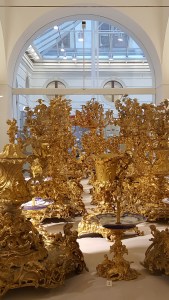
To help you better understand why I am so blown away with the “Silver Collection” you first have to understand silver is just the tip of the iceberg.  There is silver and gold and porcelain and linens and even the boxes they transported all these wonders in.  We’re talking flatware, dishes, epergnes, vases, platters, bowls, tureens, napkins, tablecloths – all in multiples like you would not believe.

I’m someone who will dutifully spend hours stomping through the rest of a huge museum for the privilege of spending time in the one small room most institutions devote to the Decorative Arts.  There are museums which have more Decorative Arts than others, for which I am grateful, but I’ve never been anywhere like this.

I think I’ll just shut up and show you the pictures Bill took for me.  Then maybe next week I’ll tell you about the rest of the Imperial Apartments.


Architecture, ART, Attractions, Cruising, Decorative Arts, DESTINATIONS, International, TRAVEL

Szechenyi Baths in Budapest Hungary

1B Hill (59)
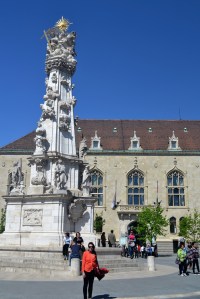
Buda Plague Statue – Castle Hill

TRAVEL THERE: TAKING THE WATERS WITH THE HUNGARIANS

Much too soon, IMHO, it was time to leave Castle Hill.  Bill (bless his heart), who does most of my photography, was just getting warmed up.  On the way up the hill he’d scouted out all sorts of lovely photo opportunities, but suddenly we were late for the bus.

Time for Lunch

Never tell Bill he doesn’t have time for something.  He’ll prove you wrong.  It was only the first full day of the cruise and I didn’t want to get a reputation for always being the last one back on the bus.  “You won’t have anytime for pictures,” I warned him, so he took a whole bunch.  Confession:  I wanted him to take the pictures and I wanted him to hurry, so I used a little travel psychology on him.

Back down at the bus, we weren’t the very last to board, but almost.  Warning: Your bus will leave you if you are late coming back from Castle Hill.  Budapest severely limits the number of buses allowed on the hill at any one time.  They monitor the comings and going of the buses and only give them a small window of time to actually be on the hill.  While an occasional infraction yields only a stiff fine, repeated offenses can bar you from the hill altogether.  Therefore, your bus will not pick you up in exactly the same place it let you off, because once you’re off, they’re high-tailing it off the hill.  They come back and get you, but don’t linger in the shops getting a souvenir for granny or you might be hoofing it back to the boat.  Not that bad of a walk, but you might miss lunch.

Here’s the pictures Bill took on the way back to the bus and down the hill to the ship.

1B Spa (5) Time for a Dip

My primary source of information for Budapest was Rick Steves.  He firmly convinced me there was no reason to go to Budapest at all, if you didn’t plan to enjoy one of the Thermal Baths and if you only had time for one Thermal bath, then you had to go to the Szechenyi Baths.  Viking graciously provides an optional shore excursion which takes passengers to a Thermal Bath, but they keep the information about which Thermal Bath very close to their vest.  I could not, for the life of me, find any information about it on any brochure, video or webpage.  My travel agent wasn’t able to get anything either and she even called her Viking rep.  Seems they don’t publish this information in case they decide they want to change up their thermal bath shore excursion locations.  Gee guys, thanks for the anxiety!

I will tell you that Viking took me to the Szechenyi Baths for our Budapest Thermal Bath Excursion, but don’t blame me if you end up at Ruda or Gellert Spas.  If you end up at one of those, be angry.  Be very angry, because there is only one Szchenyi Bath House and you want to go there.

The Viking Tor primes you for the shore excursion with fluffy towels and robes in stateroom when you come back from the City Tour.  They also provide you with a swim cap, because you are not allowed to enter some of the pools without one.

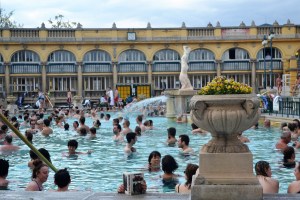
At the spa, you will have access to a changing room and locker.  From the changing rooms you’ll go to the baths, all eighteen of them.  Why eighteen?  Well, some are inside, some are outside.  Some are hot, some are cold and others are merely tepid.  Some have jets and fountains, some don’t.  Some have particular minerals, some have others.  Some are for swimming, others are for soaking.

Bill and I spent the lion’s share of our time in two of the three outdoor pools.  One of the outdoor pools is strictly for swimming laps and it’s where you’ll need the swim cap.  We didn’t go there.  We lollygagged in the other two pools with hundreds of our new Hungarian friends.  Even if you think this sounds icky, you should give it a try.  We loved it!  We did check out the indoor pools but much preferred the outdoor experience.

The Szechenyi Baths are a lot of fun, but they are also gorgeous.  Once we’d gotten prune-y from all the bathing, we got dressed and Bill started taking pictures.  Enjoy!  Then come back next week for the Budapest Sail Away.  It was spectacular!


Architecture, ART, Attractions, Cruising, Decorative Arts, DESTINATIONS, International, TRAVEL

Across the River, Thru the Tunnel and Up Castle Hill

Enjoying the sights on Buda's Castle Hill
Enjoying the sights on Buda’s Castle Hill

TRAVEL THERE: THE BUDA PART OF THE BUDAPEST CITY TOUR

With Heroes Square and Andrassy Boulevard under our travel belt, next on the must-see list was Castle Hill.  A couple hours before lunch is not enough time to see it, but that’s what we had, so we went with it.  Castle Hill is every much as touristy as Heroes Square, but the visitors seem a lot more European and there were no sweater ladies.

Matthias Church

The bus parked and we were led to the top of the hill by our apologetic guide.  We waited a few minutes outside Matthias Church while tickets were procured by our underdog tour leader and then made our way into the church.

WOW, just WOW!

The outside of the church was glorious and the deep blue sky didn’t hurt one iota, but once we walked inside the church, we were awestruck.

Matthias Church
Matthias Church

While the actual church building has only been around for about 800 years, a lot of history has happened up there.  Last week I mentioned the Magyars.  Well, they were basically marauding barbarians who made Budapest their winter camp around around 867.  Somewhere in the late 900’s the old Magyar king, Geza, noticed Christian forces were taking over Europe.  Never one to miss a trick, he decided his son, Vajk, should join the up-and-coming religion.

And here’s where the legends start.  At about the same time Geza was planning the strategic step of turning Vajk into St. Stephen, Hungary’s first Christian king, the pope dreamed the Magyars were about to convert and had a gold and silver crown tricked out with the popular gemstones of the day and sent it to Budapest with his blessings.  However, reliefs on the statue outside the church illustrate the pope showing up with the crown himself for the coronation, so you get to choose what you think happened.

Hapsburg Banners
Hapsburg Banners

And speaking of the Hapsburgs, there are some very dingy banners hanging from the columns of the church.  I was all for replacing them, until I heard they’d been up there since old Konig und Kaiser Franz Joseph’s coronation in 1867.  So much for my idea of improvement!

Perhaps the banners wouldn’t look quite so dingy if they weren’t surrounded by blazing color in every direction.  Every inch (and I mean every inch) of this beautiful interior is either gold or painted in intricate patterns.  It’s like a sampler of bargello needlepoint on steroids.

Life in the Matthias Church has not been all crowns and banners.  For awhile some of the various armies passing through used it as a barracks and stable.  I’m sure that endeared them to the population.  Then the Communists found out they could make some coin by opening it up as a tourist attraction, so they allowed the Hungarians to return it to its former and current glory – and it is glorious.

After the official tour was over we wandered around the church.  Even at the risk of sounding redundant, I’d like to repeat that this church is spectacular and you should check out every nook and cranny they will allow you into.

St. Istvan and Fisherman’s Bastion

St. Stephen's Monument and The Fisherman's Bastion
St. Stephen’s Monument and The Fisherman’s Bastion

1896 is an important year in Hungary.  Budapest was in its glory days and someone noticed it was the 1000th anniversary of the Magyar’s arrival, so the city went on a campaign of “Magyarization” and self-aggrandizement.  Not only did they virtually rebuild the city in grand style, but Hungarian became the official language and many other Magyar-honoring endeavors were undertaken.  Part of this was a fluffing up of St. Matthias Church, but they also built Heroes Square, the Fisherman’s Bastion and they erected the St. Istvan (Stephen) monument.

Since Istvan was the first Christian King of Hungary, the whole St. Stephen thing is easy to understand.  The Fisherman’s Bastion requires a little more explanation.  In Magyar times, when someone decided to attack Buda and/or Pest, the people of the area were pressed into military service.  It so happens that what eventually became Castle Hill was in the district where the local fishermen docked their boats.  So while the people of Budapest were honoring their Magyar ancestors, they built a double-decker rampart with seven pointy towers (one tower for each of the Magyar tribes) and dubbed it in honor of those fisherman of the past.

Fisherman’s Bastion is, by far, the best vantage point from which to admire the spectacular Parliament Building, along with the rest of the Pest portion of the two-part city.  We took lots of pictures, so please enjoy them and come back next week for a dip in the Szechenyi Baths.