TRAVEL THERE: THE JEWEL IN THE CROWN OF EXCURSIONS
Even the name of the shore excursion sounded exciting – Renaissance Vacation in Tuscany. I looked carefully, read all the options, but from the very first glance, I was sold. Here’s what I was sold on.
What I Wanted
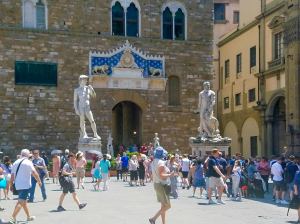
Michelangelo’s David – is there really anything else in Florence you have to see? And the Duomo, of course the Duomo and this baptistery and those doors. And the Uffizi Gallery. That’s must. Florence is a lot like Rome – a ninety minute drive from its port with entirely too many things to see.
And then there was Netflix’s The Medici’s. It was way oversexed for me to actually say I enjoyed it, but it was filmed in Florence and seeing the Medici episodes made me want to see every location.
What I Considered
Michelangelo’s David is in one museum. The Uffizi is another museum. Conveniently, the doors and the baptistery were both at one church, but the church is not the Duomo. How was I going to see them all?
The Renaissance Vacation Shore Excursion from Celebrity Cruise Lines didn’t even mention these must-see classics. It was also one of the most expensive tours offered, but just reading it transported me back to the days of da Vinci and Titian.
What I Booked
The Renaissance Vacation excursion focused on Palazzo Pitti. I actually didn’t know what a Pitti Palace was until I did a little research. The name on the palace might be Pitti, but it was all Medici and to boot,it had the Boboli Gardens. I love gardens and the Boboli is like the garden of all gardens. Only the Gardens of Versailles had hold a candle of fame to it.
I assure you, I could spend a whole day right there. The online brochure waxed eloquent about the ride through the Tuscan countryside. The list of city sights to visit sounded like a list of shooting sites for the Medici’s. I grieved over (and still grieve over) not seeing Michelangelo’s David, but the Renaissance Vacation was going to be the best excursion of the trip – I just knew it.
And the booking was so easy. With so many things to see in the area, the usual must-see list with the Leaning Tower of Pisa and the David, was getting all the attention. Once I booked the excursion I started in-depth research into what we’d be seeing. I devoured the section of my travel guide devoted to the Medici’s. I soaked in every episode of the Medici’s and mourned when the second season was over. I found a special about Italian gardens which focused on the Boboli. I opened the pages of my copy of 1000 Place to Go Before You Die and marked all the pages which would described the places I would see in Florence.
I was literally giddy – again. Would this blast from the past be the highlight of my trip as I anticipate it would. Well, you’re just going to have to keep coming back to find out, but next week, we’ll talk about Monaco.
TRAVEL THERE: NOT DOING UNTO OTHERS AS I WOULD HAVE THEM DO UNTO ME
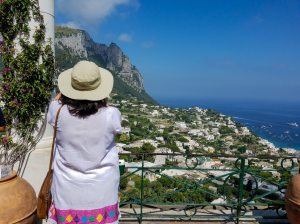
Naples is a lovely city. A traditional bus tour of the city with various stops would be a lovely way to spend the day. However, besides just being a lovely city, Naples is the gateway city for so may lovely attraction. Sorrento, the Amalfi Coast, Positano, the Isle of Capri! How does one choose which Celebrity Shore Excursion to enjoy?
What I Wanted
If I had done exactly as I wanted to, I would have hired a private guide and spent the day taking in Pompeii and Herculaneum. It would be hot, it would have been crowded and I would have been walking all day long. I would have also been in heaven.
Two cities from ancient history preserved for posterity by an extraordinary volcanic eruption, lovingly researched and restored over centuries. If I had to choose between the two cities, I would have opted for Herculeneum. Pompeii is the most famous, an entire city frozen in time, but Herculaneum had been a sort of ancient Riviera-type playground for the rich and famous. The frescoes and tile floors were supposed to be out of this world.
What I Considered
I’m not crazy. I know if you drag a bunch of people around to a bunch of places they don’t care about and wear them out at the first port of call, you are not going to be the most popular person on a cruise. I needed something a little more engaging to transition my group into the swing of things.
What I really needed was a sort of overview of the whole thing. I checked into the cost of a personal guide for the day, but in order to have sufficient space in the vehicle for all six of us, along with a driver and/or guide, was prohibitive.
What I Booked
Hoping to kick things off with a bang, I decided on something that didn’t have a very exciting title, but promised a wide variety of activities – sort a something for everyone smorgasbord. Capri, Sorrento, Pompeii didn’t grab me right off, but then I read on – jet foil to Capri, funicular ride, lunch in Florence and guided tour of Pompeii! First day planned.
Booking Nightmare
This is where the booking problem came in. I told you several blogs back that when I first looked at shore excursions, they were one price, but had gone up significantly a month later. I was new to Celebrity as a cruiser, so I had not antisciapted the shore excursion sale, but the Bagley’s had cruised with them many times. They let me know when the next promotion came along – 20% off all shore excursions. It was booking day.
Booking day lasted all day and into the next as I tried to guide everyone onto the same excursion at the same time. In the end, we were all going to the same excursion, but Jim and Melanie had been forced into another time for it. Not an auspicious way to start, but the hunt was on.
Frustrations be damned, we were booking excursions. Come back next week and let’s explore the opportunities in Florence.
Looking back on Mayan society, we might be quick to blame priests or kings, perhaps even warriors or ambassadors. Study history and you will know their sins are legion, but we allow the same sort of characters to control us today, as surely as the Mayans were controlled then.
Parallels I See
Mayans bound the foreheads of infants to achieve a fashionable look and we may wonder why anyone would do that, but don’t we rush out to rearrange anything on our bodies we don’t like? We may not file our teeth and set jewels in them, but we will pierce the skin under our lip and keep expanding the hole until those around us can see our gum line. We are perhaps even more greatly ruled by fashion than the Mayans.
Here in the United States we argue about our government, yet we allow the same politicians with their same solutions to dominate our legislating bodies year after year, forcing more and more regulations down our throat. Some of these bureaucrats are hired and appointed by our government, but too many are re-elected and re-elected long after they’ve proven how they fail to keep any promise that they make.
I’m guessing the average Mayan on the street wasn’t so different from me. My sacrificial pyramid is delivered to my house daily on my TV and computer screen and in case that’s not enough, I carry a phone, so I can check in on the mounting atrocities at any time. I listen to what the media tells me, just like the Mayans listened to their priests and royalty. I hate so much of what I see around me and yet, I feel so powerless to do anything about it.
The Mayans didn’t wake up one morning and say, “Hey, let’s have a society where the rich get richer, the powerful get more powerful and the rest of the population is ground under foot like ashes. And let’s create a religion where thousands upon thousands are murdered in gruesome ceremonies and we can pretend it makes the sun come back.” Their situation grew out of a series of circumstances. At some point, the tide could have been turned, but they let the opportunity slip away. Their great intellectual capacity and their amazing creativity could have been the foundation of a beautiful utopia, but instead it created a sort of hell.
I pray fervently that we Americans are not making the same sort of mistakes. I hope it is not too late to gain some control over our “priests and royalty.” I hope our religion of self-gratification does not one day demand the egregious sacrifice of our fellow citizens.
Forgive me my doom-saying. Travel is fun and filled with exposure to beautiful things. That’s what I usually focus on. But travel should also expose us to things that make us look at our own lives and think about the way the world is going around us. We should question whether we are doing the right things and promoting the right ideas.
Chichen Itza made me stop and think about my world. I promise to get back to the fun and the beautiful, but I will always try to see something more when I travel than mere entertainment. One more post about Chichen Itza and I am done.
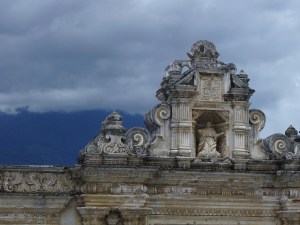
Spanish Colonial Architecture from Bill’s 2011 mission trip to Guatemala.
TRAVEL TALK: SUMMING IT ALL UP
Our return to Dallas was blissfully uneventful. I’ll spare you the details. I entertained myself with Michener’s Mexico, but as I read, another part of my brain was sorting out what I’d observed on this short vacation. My initial impressions required a lot of thought and my arrival in Dallas did not end my meditations.
Capturing My Travel Thoughts
I’ll start with the relationship between Mexicans and Spaniards. I’m actually amazed at how good their current relations are considering the history of the natives and the invaders. Spanish architecture is appreciated just as much as the ancient native sites. There doesn’t seem to be a resentment between the Mexicans and their Spanish heritage. Spain’s Catholicism has been embraced and there doesn’t seem to be any factions hoping to reignite the worship of gods who demand human sacrifice, which were the Mayans gods.
Granted the Mexicans overthrew Spanish rule during an ugly period that lasted more than a decade, but they got over it. They didn’t reject Christianity along with the rulers they ousted or tear down Spanish cathedrals. Though I am sure there was a lot of burning and looting during the war, since its been over, they seem to have developed a great working relationship. The Mexicans I have observed seem just as proud of the beauties of Spanish colonial architecture as they are of their own pyramids. Even when I visited Mexico back in the Seventies and Eighties, this seemed to be so. Most specifically, there is not the tension over monuments and flags we Americans seem to harbor in relation to our own Civil War and slavery.
I Wouldn’t Be Quite as Nice
Personally, as a Christian, I resent the Spanish for the brand of Christianity they forced down the throats of the Mexican Indians. They made most of them slaves and threatened to kill them if they didn’t convert. Not that the Europeans did a much better job anywhere else, but the Spanish Conquest of Mexico seems particularly repugnant, in both their hunger for gold and their forcible spread of Catholicism.
My guide on the Chichen Itza excursion pointed out something I’d never quite noticed before. He showed us a church decorated with serpents. According to the guide, killing those who were unwilling to convert did not seem to be all that effective with some groups of natives. So, instead the friars invited the natives to come to the Catholic Church to worship their own snake god. Though this is more humane than murder, it’s still a trick and I didn’t like to hear of it.
The Question of Christianity
Had I not mulled over the question of religion for several days, this post might have turned into a rant against the Roman Catholic Church. They’ve done a lot of things wrong from the inception of formalized religion, but in truth, little about Christianity is attractive to many outsiders today. In some places, like Central Asia for example, people are turning to Christianity in droves. They are hungry for the hope it offers, but the concept of hope is alien to Americans who see Christianity the enemy. They pull verses out of the context of the rest of the Bible and try to hold them up as messages of contempt. I fear these people miss the point.
Christianity fails any time it gains an official capacity in government. It’s one thing to have a Christian king or president, quite another to have that leader promote his faith with his power. Lead as a servant, sure. Wield your power to grow your religion – NO! Christians have made a lot of mistakes in America. They have judged others based on a faulty understanding of what they think God wants. They also took advantage of their majority and wrote laws favorable to themselves. Now we are paying the price for that power.
During the Byzantine era, the Roman government encouraged its citizens to be Christians. The emperor was Christian and he promoted Christianity in many ways, including paying bishops. Many of the subjects of the emperor joined the church, not because they embraced Christianity, but because they wanted access to their ruler. Others joined the clergy, not out of piety, but because it was a steady paycheck. The Church may have prospered under these circumstances, but true Christianity has not. The intentions may have been good, but the results were not.
Conversions which are coerced or forced in any manner are just wrong, period. A conversion to Christianity should be about faith, relationship and hope. I do blame the Roman Catholic Church for much of the antipathy felt towards Christians. It would take me thousands of words to discuss the atrocities of history, the distractions of Mariology and the veneration of saints, indulgences, Apolstolic Succession, the inerrancy of the pope, the practice of confession and absolution, transubstantiation, and so many other Catholic traditions which make me crazy. However, all Christians are human first and we all screw up really badly. Unfortunately, people judge God based on us, rather than judging us by God’s standards – and we all fall short of those.
As I stood in the plaza of Chichen Itza and considered the awful human sacrifices which were made there, it seemed to me anyone in that city should have been thrilled to learn of the God of the Bible. Instead of a stone god who expected sacrifices, the Spanish could have offered a Creator God, who sacrificed His own Son. But the message was garbled, threats were made, abuses were committed and today many Mexicans are still caught up in a religion of works, rather than a joyful relationship with the Most High God.
These misconceptions about God, Jesus and the Bible still abound. God is seen as the big killjoy of the world, because the message is still garbled. The code of conduct outlined in the Bible is seen as a list of criteria to get into heaven, but that’s a total misrepresentation of Truth. Shame on the religious people who promote this heresy.
I could go on and on, but I won’t. Next week I will leave religion and move on to politics.
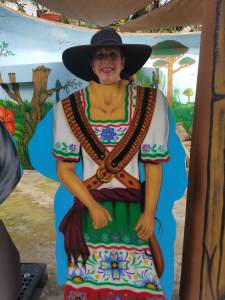
Waiting for us beside our tour bus after the tour of Chichen Itza were our hosts from Cancun Passion. Cancun Passion was the actual touring company we’d booked through Shore Trips, which had been recommended to us by Sandra Rubio at CTC Travel. I can heartily recommend all of those entities to you.
I love my friends at CTC Travel. They are like cheerleaders, urging me on in my efforts to see the world. You will love working with them as you plan your own travels. Shore Trips is a great way to book excursions, all over the world. They offer a wide variety of tours wherever you might go and their website is secure, informative and easy to use. When it came to visiting Chichen Itza from Cancun, Shore Trips curated the very best choices of tours, in my opinion. But let me tell you about Cancun Passion.
Service with a Smile
From the moment we connected with Cancun Passion, in the lobby of our hotel, we knew we’d made a good choice. Their representative spoke perfect English, welcomed us with a hearty smile and ushered us into a pristine vehicle, which still had its new-car smell. I can’t say that the next hour or so of picking up fellow passengers was all that much fun, but what I liked was that they kept us abreast of what was going on, so we weren’t left wondering if we’d actually ever depart the city of Cancun.
At one point, a guide showed up wearing my hat down the aisle of the bus. I’d left the hat in the first bus we’d climbed onto, when we changed to the larger vehicle. I don’t have any idea what difficulties they went through to unite me with my hat, but it showed a level of care which I really appreciated. I’ve left many hats in many vehicles around the world and this is the first that was ever returned to me.
The light breakfast they served on the way to Chichen Itza was more than adequate. They had generous baskets overflowing with all kinds of pastries from the sweet to the savory. They served coffee and orange juice. I drink neither of those on a regular basis, but I know I am in a very small minority and should I have asked, they could have given me water. The repast was offered with good cheer and second, thirds and fourths were available if you wanted them.
At every stop we knew exactly why we were there, what opportunities we had for necessities, shopping or entertainment. We also knew exactly when we were supposed to be back on the bus. We always had a convenient parking spot and not once did we have to wait for very long, before everyone was on the bus and we were back on our way.
As we got off the bus at Chichen Itza, they gave us a nice bottle of water, not one of those half bottles some folks give you, but a bottle generous enough to provide hydration throughout the visit. They also had a big basket of small bbq sandwiches to keep hunger at bay as we visited the site. The meat-filled roll was delicious.
I particularly appreciated our tour guide. He was not a pedantic as our Egyptian guide nor silly like some of the other Mayan guides, who had their guests clapping and yelling at the monuments. He also did not engage in guessing games to present the pertinent information about the site, like the jerk who showed us around Passau and scolded us because we didn’t already know the information we’d hired him to tell us. Our guide at Chichen Itza was proud of the accomplishments of his ancestors, but also honest about the horrors they committed.
Boarding the Bus at Chichen Itza
So far, our excursion had been almost perfect. Perhaps a private tour would have been more accommodating to our personal needs and desires, but it would have cost a whole lot more. For an affordable group tour, they did a great job. However, even if I had harbored some minor grudge against them, all would have been forgiven as we approached the bus, hot and tired from our tour of the archaeological site.
Waiting for each guest was a cool wet hand cloth to wipe away the dust and heat of Chichen Itza. Also, from the chilly interior of an ice chest each guest was offered a beverage. Water, soda and beer was available. I can’t remember when a Corona had tasted so good.
We have a buffet and a swim coming, but that can wait until next week. Join me then for more adventures.
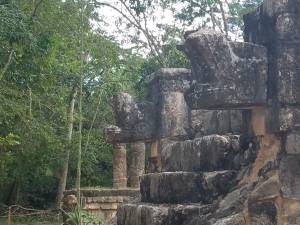
Last week I mentioned the Spanish and their influence on Mexico. I was horrified by the Mayan culture at its apex, but by the time the Spanish arrived, the jungle had reclaimed Chichen Itza. All that remained was a pile of stones to loot for building materials. The magnificence of that society had crumbled.
Peeling Back the Jungle
Historians and archaeologists have many speculations on the downfall of the Mayans. Their glorious city of Chichen Itza was first taken over by the Toltecs and then abandoned for reasons that are still unknown. How did it happen? How did such an advanced society merely fade into the jungle?
When you go to Chichen Itza today, you must use your imagination to understand just how astounding it would have been to walk among the monuments in their glory. The rain and the wind have softened the many carvings on the faces of the buildings and walls. Mere shadows of pigment hint at the remarkable murals once covering every inch of exposed stone. How overwhelming it must have been!
Standing in the Plaza
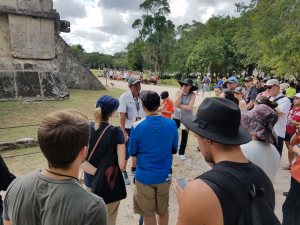
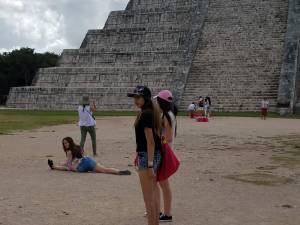
As I stood there trying to imagine the city ripe with the beauty it once displayed and the engineering it had taken to create it, I was distracted by those around me. Overweight senior citizens from America, sweltering in the sun and wondering why they had ever paid someone to bring them to this overrated steam bath. Younger and thinner tourists, from around the world, frolicking like they were at a theme park, rather than an archaeological site. Native Mayans leading tours, some trying to be comedians, while others shared the importance of the site’s history, but all hoping their meager salaries would be supplemented by generous tips from their audience.
And throughout the site, along every pathway, under every tree, were other Mayans. Their marketplace no longer had a roof, so they huddled, one after another in the shade, to avoid the blasting heat of the sun, selling their wares. One vendor offered pretty much the same thing as another. Some focused on wearable souvenirs, while others sold trinkets to decorate your home. Too many vendors demonstrated a wooden device that made the sound of a jaguar when you blew into it. We were sick to death of the sound before we left. More pleasantly, some vendors played melodies on rustic pipes. Occasionally, you would see a craftsman, carving a beautiful statue with his own hands, while a quick inspection of other souvenirs would reveal a label professing they’d been made by hands in other countries, where the workmen would earn even less than a native craftsman.
How much easier it would have been to join my fellow tourists in their boredom or their freewheeling photography sessions. I could have spent my time shopping among the tables of the modern day merchants, comparing the prices and workmanship of their offerings. Why was I mired in gloomy thoughts of horrific bloodletting and an advanced society which was doing almost everything wrong when it came to the good of their citizens? What was Chichen Izta trying to tell me?
This is not a conundrum I was able to solve in the few hours I walked among its monuments. Instead I would walk back to the bus with a heavy heart and conflicting thoughts. My conclusions would have to work themselves out over the coming days.
On to More Amusing Adventures
It was time to board the bus. A buffet lunch waited for us and then we’d be headed to visit a cenote. I shook over my pondering and looked forward to a good meal. The traveler in me made way for the tourist. Come back next week and we’ll consider lighter subjects.
Last week I shared my first impressions of Chichen Itza. The longer I stayed the darker my thoughts became. As if in response to the cartwheeling girls in front of the pyramids, I felt the lives of the Mayans deserved to be carefully considered and now, days later, I am still pondering my observations.
Marketplace of the Macabre
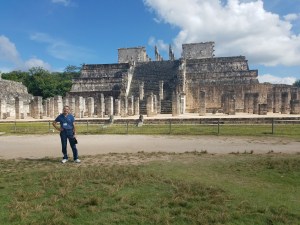
As if to emphasize my train of thought, I realized the structure adjacent to the altars was the marketplace. Beautiful rows of columns raised their heads to the sky, but like the Hypostyle Hall in Karnak, these columns once bore the weight of a heavy roof to protect the items of commerce available in the market. Like us, Mayan traders traveled to distant lands and brought back beautiful items used for adornment, which were sold next to agricultural products and weapons and cosmetics. Did the market close during the sacrifices? I doubt it. Instead, like a big box store getting ready for Black Friday, they’d hired extra help and filled their shelves with extra merchandise.
After showing us the main plaza and describing the crowds that once filled it during the days of sacrifice, our guide took us to the back of the pyramid where evidence of vandalism was apparent, but the vandalism is not recent. The Spanish came and disregarded the value of the Mayan ruins by peeling off layers of stone to build their own homes. The Spanish were not alone in this type of activity. The beautiful marble which once covered the Egyptian pyramids was used to build later monuments for people who saw little reason to protect the beauty of past engineers. How is that different from the cartwheeling girls?
Men of Science
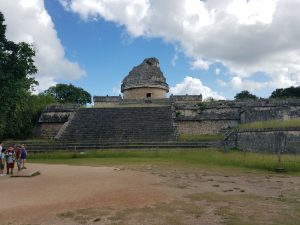
At the back of the pyramid, the guide gave us a choice. We could stay in the plaza to shop and take pictures or visit the observatory. I was hungry for more, so we followed the guide. Removed from the plaza, but still in the shadow of the pyramid stood an edifice for tracking the stars. They performed accurate science in this place, science that measured the routes of the stars and their dance across the sky. The statistics they calculated have proven to be as accurate as those of our own scientists, with their modern equipment, almost to the second.
The men of science in that day, knew from centuries of observation, the days would get longer, just as surely as they watched them get shorter. It had always been that way. Instead of proclaiming proven fact, they used their data to pick the day the sacrifices would be made. To declare the truth would have reduced their own power, so they ignored what they knew and instead worked hand-in-hand with the politicians, celebrities and leaders to deceive the general public – those standing below the pyramid and those falling lifelessly down the steps. Does that sound at all familiar to you? It does to me.
The Pleasure Palace
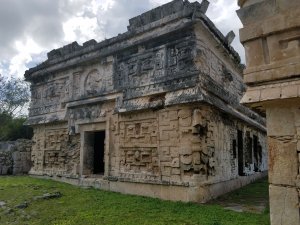
Just beyond the Observatory, still in sight of the pyramid, is a huge palace, mostly still standing. You can see intricate lattices of stone decorating the walls of the building, graceful columns in the walled garden and steps winding up to a balcony. Was the spot chosen for its proximity to the pyramid? Did they walk to the plaza or watch them from their pleasant garden? Who were the royals who lived in the shadow of so much death and right next door to a scientific institution that could have used their data to end the grisly performances of religion?
The palace marked the beginning of a residential area. Their neighbors were priests, other members of royalty, high level political appointees, the families of warriors and of the successful merchants whose businesses filled the market. Their primitive HOA offered a steam bath and water was delivered daily from the cenote by slaves. Other slaves brought food from the harvests to feed them. Their house slaves swept the floors, served their meals, dressed their hair and raised their children.
It was fantastic, this life the powerful had built for themselves. Certainly, it was also horrific, but did they notice or even care? What if you had lived in those times, at that place? Would you have joined the circus that protected your place in society or would you have lived each day in horror, wondering how your lone voice could make a difference against the odds?
If these impressions seem different to you from my usual travelogue, I must agree with you. They seem different to me, too. Wherever I travel and whatever I see, I try to put myself in the place of those who lived the life I am observing. I try to use their experiences to better understand what I observe in my own world. I’ve stood alongside ancient monuments like Stonehenge and the Temple at Karnack. I’ve visited magnificent cathedrals and breathtaking palaces. I’ve walked through significant battlegrounds and beautiful gardens. Never have I been as disturbed by what I saw as I was at Chichen Itza.
I’ve barely touched on the influence of the Spanish in Mexico. At Chichen Itza all you really see of them is the stones they took away from the pyramid, which is in many ways symbolic of the other things they took away. What they brought with them was a religion, which would replace the grisly sacrifices of thousands upon thousands with the sacrifice of One, but were they in truth any more benevolent than the murderous priests of Chichen Itza? Let’s talk about that next week.
Our visit to Chichen Itza was a very long day and there is no way I can cover all of it in one post, so I’ll start with the logistics of the day and we’ll work from there.
Finally Chichen Itza
Though Chichen Itza has always been at the top of my Yucatan Wish List, I didn’t make it either of the other two times we visited the area. Both of our previous visits have been via cruise ship to the port of Progresso and Chichen Itza is significantly inland from there, so we chose more accessible Mayan sites.
The first time we visited the ruins at Dzibilchaltan and it was a particularly enjoyable shore excursion, complete with lunch and a rodeo. The archaeological site was interesting and there was a wonderful museum. Last time we went to Xcampo. It was a smaller site, but still interesting. So, we’re getting pretty knowledgeable about the Mayans, but nothing can prepare you for Chichen Itza. It is both marvelous and horrid.
Up Early& Out Late
The first thing the guidebook I bought warned me about Chichen Itza was to avoid excursions from Cancun, because so much time is spent in transit. Well, I appreciated the advice and understood the reasoning, but this was it. If I didn’t go this time, chances are I might never again get the opportunity.
As we shopped excursions I saw two versions of the trip over and over. Either you had to be on a bus by 4 AM or you left between 7 and 8. The problem I discovered however, was that when you took later tours, you were in Chichen Itza during the hottest part of the afternoon, because all the tours stopped for lunch before going to the site.
Then Sandra Rubio, my travel agent at CTC Travel turned me on to ShoreTrips.com and they had a package called the Chichen Itza Plus. This version of the trip would pick us up between 7 and 8, but we’d go to the site before lunch. SOLD!
Since we were among the first to be picked up, we had to be in the lobby at 7:10. When we got there after a quick visit to the breakfast buffet, they were waiting for us. It was quite the ordeal to get out of town though. The bus they picked us up in was bigger than the airport transport vans, but not as big as the full-sized tour buses. We stopped at several hotels in the smaller bus and then traded to the big bus, but even then we had many more stops to make.
All that driving took a long time, but it was interesting to drive around and see other parts of Cancun. I’d say it was about nine when we finally headed to Cancun. They served a small breakfast – pastries, coffee and orange juice. We were glad we’d hit the resort’s buffet.
The drive to Chichen Itza was about an hour and a half. They stopped off at a shopping opportunity to use the restroom. I was focused on sightseeing, not shopping, so they didn’t get to sell me anything. Another short drive took us to the archaeological site – which I’ll go into in detail later.
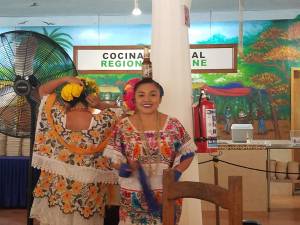
After a couple of hours at the site, we went back to the shopping opportunity to have a very nice buffet lunch. In my opinion, they would have gotten a lot more shopping out of me if they’d have let me use the restroom at Chichen Itza and given me shopping time after lunch.
Then, after lunch we made another short drive to Ik Kil Cenote. I’ll also tell you more about that in a later blog, but it was a great way to end the day. Well, the day wasn’t quite over. We still had to drive back to Cancun, which seemed to take forever in the dark.
As we neared Cancun, the lights inside the bus switched on, a recorded version of “Tequila” was played on the loudspeaker and one of our guides had donned a wild get-up that I supposed was intended to be Mayan. They served shots of tequila to anyone who wanted one, but right then it didn’t even sound good to me. I was whupped.
It seemed like midnight when we got to the hotel, but I think it was only about 8:30. Come back next week and I’ll tell you about our time in Chichen Itza.
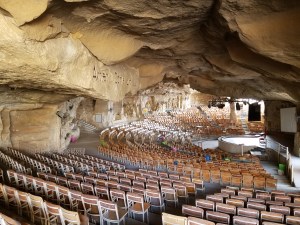
There is a section of Cairo on Mokattum Mountain that is the home of the garbage people. They are outcasts of polite society. It’s enough that they are garbage collectors, but they are also Christians, almost 100% of them, and in a predominately Muslim country, that too is a problem. Yet rarely have I been in a place with as much joy.
Curiosity Got Me There
Sometimes in Egypt it’s hard to discern what is fact and what is just tradition. Take the Pompey Pillar in Alexandria for instance. Everybody knows the pillar has nothing at all to do with Pompey, yet his name continues to cling to it.
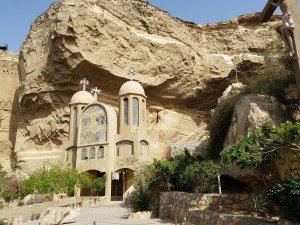
Mokottum mountain has a lot of traditions attached to it, not just the story of the Coptic pope with the faith of a mustard seed, who got the mountain to move. The name of the mountain, which means “broken mountain,” is considered proof of …I’m not sure what to call it – event, miracle, legend, tradition. I’ve also heard a story of a Bible being found floating in the Nile opened to a particular verse which led to the location of this church – or another church. The details are fluid. With so much smoke about Mokattum, I wanted to check out the fire.
Mokattum Church
The Zabbalene (garbage collector) neighborhood of Cairo is not a garden spot. It has a very distinctive, unpleasant and fetid odor in the air. As we rolled through the area the reason became apparent. Huge piles of garbage sit everywhere, waiting to be sorted through. Someone opened the garage-like door of a warehouse as we drove by. Inside were more mounds of garbage, which I presume were more valuable than those which sat in the open air. At this point in the tour I was still a curious tourist.
We arrived at the entrance of the church and joined a small group being lectured to by someone from the church. Izzat and Zuzu disappeared for this part. At first it was the usual tour guide stuff. This guy started this church this way in this year. We have this many members.
The facts buzzed around my head as I followed the guide from one area of the church to another. I shifted from listening to observing. This guy was neatly groomed, but it was obvious his outfit came from the piles of garbage. He could have used a haircut, but you could tell he had a self assurance and self esteem many pampered US teens could benefit from.
I also saw joy. He loves his church. He was so excited to share each and every piece of information with us. He was so proud of the carvings on the wall. He is in awe of the huge number of people who show up each week to worship. It’s the largest church in the Middle East.
His joy was not just associated with the church. His personal testimony is that God loves him, protects him and provides for him. He is so grateful to be a part of the Body of Christ.
I saw how I must look to him – a privileged tourist. Imagine how many meals, how much education, how much medical care and other basic needs could be filled with the money Bill and I had spent to be right there at that time. He had every reason to resent me and my intrusion into his life, but instead he was thrilled we had shown an interest in his community. He hoped we’d come back and worship with him. We spoke to him briefly to tell him how much we admired the church and were humbled by his joy. He spoke to us as an equal, holding his head high and treating us like a fellow brother and sister in Christ.
After the tour, Bill visited the restroom and could not resist taking this picture. It broke our hearts. I thought of all our country club mega-churches with our slick-talking celebrity pastors. I thought of the people who prefer to participate in ministries that will take them on vacation mission trips. I thought of all the $1-3 donations people thoughtlessly tack onto their grocery bill or pet shop total, and then forget about by the time they get to their car. I thought of all the money we spend on saving cats and dogs, when these people so desperately need a little saving. How in the world does that stack up to the needs of those in Mokattum?
Those garbage collectors have it right and I admire them. I walked away from Mokattum Church a little different than I arrived. The guide’s love and acceptance of me expanded my own heart a little bit. I didn’t come home and sell everything that I have, but I’ve got a new understanding of the joy of the Lord and I’m trying to practice it with the same abandon as my brother in Mokattum.
It was on odd place to go for our final tour in Egypt. Luxury hotels, museum visits, yacht trips and a city of garbage collectors. Next week, I’ll share our last few hours in Egypt. I’m writing this particular post on a pretty day in February, knowing it will be posted in August, and that’s a little weird. Who knows what adventures will follow this blog series!
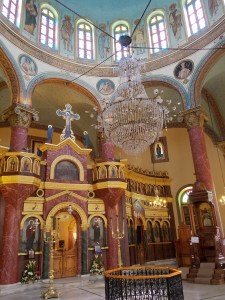
We visited St. George’s. It’s nice, but confusing. There’s all these pictures of St. George and the dragon, but St. George is a Roman soldier martyred because he would not give up his faith. No dragons in the story, so don’t ask me. It’s also confusing, because it started out as a Roman Catholic Church, but is now is a convent for Greek Orthodox nuns and old George is a Coptic saint.
We visited the very old Jewish Synagogue which they call the New Synagogue, because the current building was built in the 1890’s and this building is one of three known synagogues on this site. However, according to tradition, there’s been a synagogue here since ancient times. I mentioned a few weeks ago that it was built on the site where Pharaoh’s daughter discovered Moses in the bullrushes.
Hanging Church Depiction of Moses in the Bullrushes
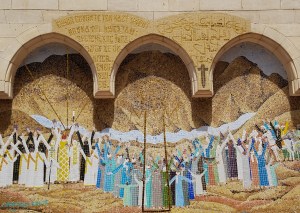
They say stuff like that all the time in Egypt. St. Catherine’s Cathedral out in the Sinai has THE Burning Bush. One of the murals at the Hanging Church depicts the Moses in the bullrushes story. There’s also a mural of the documented story of when faith actually moved a mountain. You really need to get to Egypt.
One of the sad things I learned was that while there was a large Jewish community in Cairo for centuries, it has virtually disappeared. The Synagogue is a tourist attraction, not a place of worship. Imagine a congregation, whose place of worship was originally associated with the story of Moses and which was perhaps the place Joseph worshiped when he was in Egypt, no longer having any Jews to worship in it.
Another important miracle recorded in the murals of the Hanging Church is the moving of Mokattum Mountain. A Muslim Caliph was ready to do away with Christians altogether when a bishop made a deal with him. If he could get a mountain to move then the Christians were safe. According to tradition, the bishop had everyone pray and then they had a mass at the foot of Mokattum Mountain at the edge of Cairo. Lo and behold the mountain jumped up into the air and the Christians were saved.
In recent years a church has been planted in a cavern out there at Mokattum and Bill and I would travel there before the day was over, but for now, I’ll round out my tour. On the way into the area I saw a shop selling shawls. I love shawls and capes. Bill promised we’d stop back by on the way out, probably thinking I would forget all about it – and who knows, I might have – but Zuzu remembered and now I have this beautiful shawl.
The shawl I saw on the way in was not the one I ended up with. I saw a pretty shawl that I thought would be great for evening wear and the price was minuscule. When I went back I saw this gorgeous, heavy, reversible number and asked if all the shawls were the same price. “Yes,” was his answer. I know value when I see it. I immediately abandoned the evening style and held on to this one until Bill paid for it.
Come to find out, the shawl I chose is hand woven goats wool. A tag identified the Egyptian craftsman who made it. We probably should have paid $100 for it. I’d be surprised if Bill paid $10. He’d bargained so mercilessly that he was embarrassed when we walked out of there. Once again, not understanding Arabic saved me. I would have told Bill to pay the man his price and quit bargaining.
Next week we’ll move on to Mokattum Mountain, but first, enjoy these beautiful photos.

 TRAVEL THERE: KUDOS TO CANCUN PASSION
 TRAVEL TALK: THE DISAPPEARANCE OF A CULTURE
 Standing in the Plaza
 TRAVEL THERE: MORE IMPRESSIONS OF CHICHEN ITZA
 Men of Science
 The Pleasure Palace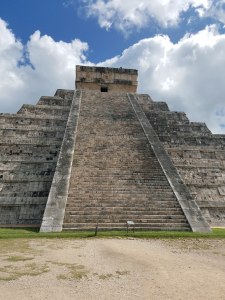
 After a couple of hours at the site, we went back to the shopping opportunity to have a very nice buffet lunch. In my opinion, they would have gotten a lot more shopping out of me if they’d have let me use the restroom at Chichen Itza and given me shopping time after lunch.
 TRAVEL THERE: HUMBLED BY THEIR HUMILITY
 Mokattum Church
 After the tour, Bill visited the restroom and could not resist taking this picture. It broke our hearts. I thought of all our country club mega-churches with our slick-talking celebrity pastors. I thought of the people who prefer to participate in ministries that will take them on vacation mission trips. I thought of all the $1-3 donations people thoughtlessly tack onto their grocery bill or pet shop total, and then forget about by the time they get to their car. I thought of all the money we spend on saving cats and dogs, when these people so desperately need a little saving. How in the world does that stack up to the needs of those in Mokattum?
 TRAVEL THERE: WRAPPING UP OUR TOUR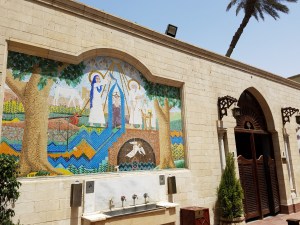
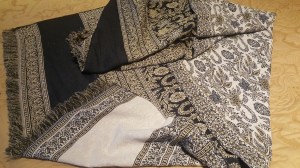 In recent years a church has been planted in a cavern out there at Mokattum and Bill and I would travel there before the day was over, but for now, I’ll round out my tour. On the way into the area I saw a shop selling shawls. I love shawls and capes. Bill promised we’d stop back by on the way out, probably thinking I would forget all about it – and who knows, I might have – but Zuzu remembered and now I have this beautiful shawl.


 jane sadek